
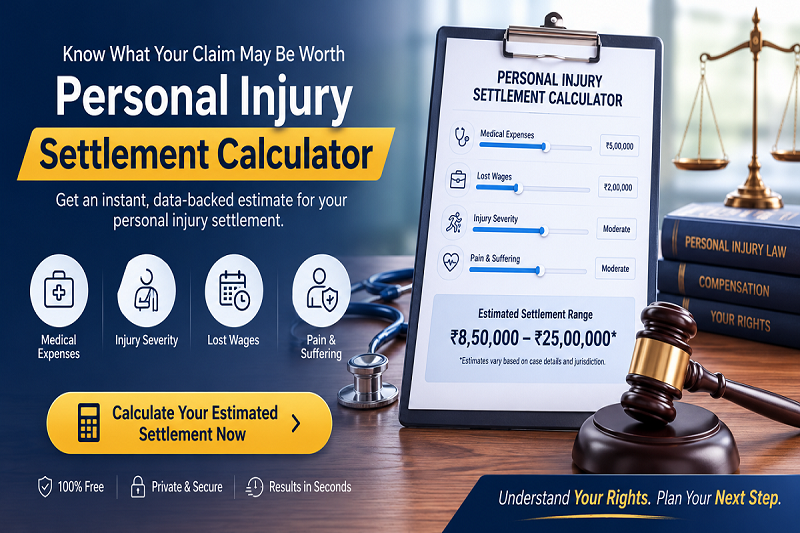
Personal Injury Settlement Calculator
Estimates a possible settlement range using medical bills, lost income, and injury severity.
Your Estimate
Want this estimate reviewed or want a professional to follow up? (Optional)
This calculator provides a rough, educational estimate only. It is not legal, financial, or tax advice, and results may not reflect your actual situation. Please consult a licensed attorney or professional before making decisions.
Frequently Asked Questions
How accurate is this personal injury settlement estimate?
It is a ballpark estimate using the common "multiplier method" insurance adjusters and attorneys sometimes use informally. Actual settlements depend on evidence, jurisdiction, insurance policy limits, and negotiation, and can be higher or lower than this estimate.
What is comparative negligence?
It is a rule used in many places where your compensation is reduced by your own percentage of fault for the accident.
How Does a Personal Injury Settlement Calculator Work?
If you’ve been injured in an accident, one of the first questions that may come to your mind is, “How much money could my case be worth?” That’s exactly why many people use a Personal Injury Settlement Calculator.
A settlement calculator gives you an estimated value of your claim based on the information you enter. It is a quick way to understand what your case might be worth before speaking with a lawyer or an insurance company.
However, it is important to remember that no online calculator can tell you the exact amount you will receive. Every personal injury case is different. Two people with similar injuries can receive very different settlement amounts because each accident has its own facts, evidence, insurance coverage, and legal rules.
Think of this calculator like using an online mortgage calculator or a fuel cost calculator. It gives you a useful estimate, but the final number depends on many real-world factors.
What Is a Personal Injury Settlement?
A personal injury settlement is an agreement where the person or company responsible for an accident pays money to the injured person. In return, the injured person agrees not to file a lawsuit or ends an existing legal claim.
Most personal injury cases in the United States are settled outside of court. This saves both sides time, money, and stress.
A settlement may include money for:
- Medical bills
- Future medical treatment
- Lost wages
- Reduced ability to earn money
- Pain and suffering
- Emotional distress
- Property damage
- Other accident-related losses
The goal of a settlement is to help the injured person recover financially after suffering harm because of someone else’s negligence.
What Information Does the Calculator Use?
Most settlement calculators ask for information such as:
- Total medical expenses
- Lost income from missing work
- Estimated future medical costs
- Property damage (if any)
- Pain and suffering level
- Percentage of fault
- Insurance limits
The more accurate your information is, the more useful your estimate will be.
For example, if you only enter your hospital bill but forget about physical therapy or future treatment, your estimate may be much lower than your actual claim.
Why Is the Result Only an Estimate?
Many people are surprised when they learn that there is no official formula used for every personal injury settlement.
Insurance companies, lawyers, and courts consider many different factors before deciding how much compensation is fair.
For example:
- Was the other driver clearly at fault?
- Were your injuries serious?
- Did you need surgery?
- Will you fully recover?
- Can you return to work?
- Do you have permanent disabilities?
- Is there enough insurance coverage available?
Because every accident is unique, no calculator can promise an exact payout.
Instead, it provides a reasonable starting point to help you understand the possible value of your case.
What Factors Affect a Personal Injury Settlement?
Several important factors can increase or decrease the amount of compensation you may receive. Understanding these factors will also help you use the calculator more accurately.
Let’s look at each one in detail.
1. Severity of Your Injuries
The seriousness of your injury is one of the biggest factors in determining a settlement.
In general, more serious injuries usually result in higher settlements because they often require longer treatment, more time away from work, and greater pain.
For example:
Minor Injuries
Examples include:
- Small cuts
- Minor bruises
- Mild whiplash
- Sprains
- Temporary muscle pain
These injuries usually heal within a few weeks or months.
Moderate Injuries
Examples include:
- Broken bones
- Torn ligaments
- Shoulder injuries
- Herniated discs
- Moderate burns
These injuries often require surgery, physical therapy, or months of recovery.
Severe Injuries
Examples include:
- Brain injuries
- Spinal cord injuries
- Multiple fractures
- Permanent disabilities
- Loss of limbs
- Severe burns
These injuries can change a person’s life forever and usually result in much larger settlements.
2. Medical Expenses
Medical costs are one of the easiest damages to calculate because they are supported by bills and records.
Medical expenses may include:
- Emergency room visits
- Ambulance charges
- Hospital stays
- Surgery
- X-rays
- MRI scans
- CT scans
- Prescription medicines
- Physical therapy
- Chiropractic care
- Medical equipment
- Follow-up appointments
If doctors expect you to need treatment in the future, those future costs may also be included.
Example
Imagine Sarah is injured in a car accident.
Her medical expenses include:
- Ambulance: $1,200
- Emergency room: $4,500
- Surgery: $18,000
- Physical therapy: $5,000
- Medication: $600
Her total medical expenses are:
$29,300
These costs become an important part of her settlement value.
Always keep copies of:
- Medical bills
- Doctor reports
- Prescriptions
- Treatment records
- Receipts
These documents help prove your losses.
3. Lost Wages
Many injuries prevent people from working.
If you miss work because of an accident, you may be able to recover the income you lost.
This can include:
- Hourly wages
- Salary
- Bonuses
- Overtime
- Commission
- Self-employment income
For example:
David earns $900 per week.
He cannot work for 8 weeks after his accident.
His lost wages are:
$900 × 8 = $7,200
If your injuries permanently reduce your ability to work, you may also claim loss of future earning capacity.
This is often much larger than temporary lost wages.
4. Future Medical Treatment
Some injuries do not heal quickly.
A person may need:
- More surgeries
- Physical therapy
- Pain management
- Home nursing care
- Wheelchairs
- Prosthetic limbs
- Rehabilitation
- Mental health counseling
These future expenses can become a major part of a settlement.
For example, someone with a spinal injury may require medical treatment for many years after the accident.
Doctors and medical experts often estimate these future costs.
5. Pain and Suffering
Not every loss can be measured with a receipt.
Pain, emotional stress, and reduced quality of life are also important.
This is called pain and suffering.
It may include:
- Physical pain
- Anxiety
- Depression
- Fear of driving again
- Loss of sleep
- Emotional trauma
- Permanent scars
- Reduced enjoyment of life
For example, imagine two people each have medical bills of $20,000.
One person fully recovers after six weeks.
The other person develops permanent back pain that affects every part of daily life.
Even though the medical bills are the same, the second person’s pain and suffering may be much greater, leading to a higher settlement.
6. Property Damage
Some accidents damage personal property as well.
Common examples include:
- Car repairs
- Motorcycle repairs
- Bicycle replacement
- Mobile phone damage
- Laptop damage
- Glasses
- Clothing
- Personal belongings inside the vehicle
Property damage is usually added separately from injury compensation.
7. Who Was at Fault?
Fault plays a major role in personal injury claims.
If someone else caused the accident, they may be responsible for paying damages.
However, some accidents are shared between both parties.
For example:
- Driver A was speeding.
- Driver B ran a red light.
Both drivers may share responsibility.
Many states reduce settlement amounts if the injured person was partly responsible for the accident.
This is known as comparative negligence.
Example:
Suppose your total damages equal $100,000.
The court decides you were 20% responsible for the accident.
Your compensation may be reduced by 20%.
Instead of receiving $100,000, you may receive $80,000.
The exact rules depend on the state where the accident happened.
8. Insurance Policy Limits
Even if your injuries are worth a large amount, the available insurance coverage can affect how much money you actually recover.
For example:
Suppose your damages total $500,000, but the at-fault driver’s insurance policy only covers $100,000.
Unless there are additional insurance policies or other sources of recovery, collecting the full amount may be difficult.
Because of this, insurance limits often play an important role during settlement negotiations.
Why Honest Information Matters
When using any settlement calculator, always enter honest and accurate information.
Avoid guessing or exaggerating your injuries.
If your case eventually goes to an insurance company or court, medical records, employment records, and other evidence will be reviewed.
An estimate based on accurate information is much more useful than one based on unrealistic numbers.
Average Personal Injury Settlement Amounts
One of the most common questions people ask is:
“How much is my personal injury case worth?”
The honest answer is it depends.
There is no fixed amount that every injured person receives. Some claims settle for a few thousand dollars, while others may be worth hundreds of thousands—or even millions—of dollars.
The value of your case depends on several factors, including:
- How serious your injuries are
- Your medical expenses
- How much work you missed
- Whether you will fully recover
- The insurance coverage available
- The strength of the evidence
The table below shows general settlement ranges based on publicly reported cases and common insurance practices. These are only estimates and should not be considered guarantees.
| Injury Type | Typical Settlement Range* |
|---|---|
| Minor Cuts and Bruises | $1,000 – $10,000 |
| Whiplash | $5,000 – $30,000 |
| Broken Finger | $10,000 – $35,000 |
| Broken Arm | $20,000 – $100,000 |
| Broken Leg | $30,000 – $150,000 |
| Back Injury | $20,000 – $250,000 |
| Neck Injury | $15,000 – $200,000 |
| Shoulder Injury | $20,000 – $150,000 |
| Knee Injury | $20,000 – $150,000 |
| Burn Injury | $30,000 – $500,000+ |
| Brain Injury | $100,000 – Several Million |
| Spinal Cord Injury | $250,000 – Several Million |
| Wrongful Death | Varies Widely |
*These are general estimates only. Every case is different.
Why Two Similar Injuries Can Have Different Settlements
Imagine two people both break their leg in separate car accidents.
Person A
- Needs a cast
- Recovers in three months
- Returns to work
- No permanent problems
Settlement may be moderate.
Person B
- Needs surgery
- Cannot work for eight months
- Suffers permanent pain
- Cannot play sports again
Settlement may be much higher.
Even though both people had a broken leg, the long-term effects are very different.
Understanding Pain and Suffering
Medical bills are easy to calculate because you receive invoices from hospitals and doctors.
But what about:
- Physical pain?
- Emotional stress?
- Anxiety?
- Sleepless nights?
- Missing family activities?
- Permanent scars?
These losses are called pain and suffering damages.
Although they don’t come with receipts, they are often an important part of a personal injury claim.
How Pain and Suffering Is Estimated
Insurance companies and attorneys may use different methods to estimate pain and suffering. One common approach is the multiplier method.
The idea is simple:
- Add up your economic damages (medical bills, lost wages, and similar financial losses).
- Multiply that amount by a number that reflects how serious the injury is.
For example:
- Minor injuries: 1.5 to 2
- Moderate injuries: 2 to 3
- Serious injuries: 3 to 5 or more
Example
Suppose:
- Medical bills: $25,000
- Lost wages: $10,000
Total economic damages:
$35,000
If the injury is considered moderate and a multiplier of 2.5 is used:
Pain and suffering estimate:
$35,000 × 2.5 = $87,500
Estimated total damages:
- Economic damages: $35,000
- Pain and suffering: $87,500
Estimated claim value: $122,500
Remember, this is only one possible method. Insurance companies are not required to use the same multiplier in every case.
What Can Increase the Multiplier?
Certain facts can make an insurance company or jury believe the injury had a greater impact on your life.
Examples include:
- Permanent disability
- Surgery
- Long recovery time
- Severe scarring
- Brain injury
- Chronic pain
- Emotional trauma
- Permanent loss of movement
- Future medical treatment
The more serious the long-term impact, the higher the pain and suffering damages may be.
What Can Lower a Settlement?
Some situations may reduce the value of a claim.
Examples include:
- You delayed medical treatment.
- There is little evidence of your injuries.
- You ignored your doctor’s advice.
- You missed medical appointments.
- You were partly responsible for the accident.
- Your injuries healed quickly.
- The available insurance coverage is limited.
Being honest, following medical advice, and keeping good records can help strengthen your case.
Common Types of Personal Injury Cases
Personal injury law covers many different kinds of accidents.
Let’s look at some of the most common ones.
Car Accidents
Car accidents are one of the leading causes of personal injury claims.
Common causes include:
- Speeding
- Distracted driving
- Texting while driving
- Running red lights
- Drunk driving
- Reckless driving
Possible injuries:
- Whiplash
- Broken bones
- Head injuries
- Back injuries
- Internal injuries
Damages may include:
- Medical expenses
- Lost wages
- Vehicle repairs
- Pain and suffering
Truck Accidents
Commercial trucks are much larger than passenger vehicles.
Because of their size and weight, truck accidents often cause severe injuries.
These cases can be more complicated because multiple parties may be responsible, including:
- The truck driver
- The trucking company
- A maintenance company
- A manufacturer
Motorcycle Accidents
Motorcyclists have very little protection compared to people inside cars.
Common injuries include:
- Road rash
- Broken bones
- Head injuries
- Spinal injuries
- Permanent disabilities
Even low-speed motorcycle accidents can result in serious injuries.
Bicycle Accidents
Cyclists can be injured when drivers:
- Fail to yield
- Open a car door into traffic
- Drive distracted
- Turn without checking for bicycles
Possible compensation may include:
- Medical bills
- Bicycle replacement
- Lost wages
- Pain and suffering
Pedestrian Accidents
Pedestrians are especially vulnerable because they have no physical protection.
Common causes include:
- Speeding
- Distracted driving
- Failure to stop at crosswalks
- Drunk driving
These accidents often result in severe injuries that require long-term medical care.
Slip and Fall Accidents
Property owners have a duty to keep their property reasonably safe.
Slip and fall accidents may happen because of:
- Wet floors
- Broken stairs
- Loose carpets
- Ice or snow
- Poor lighting
- Uneven sidewalks
These cases often depend on proving that the property owner knew—or should have known—about the dangerous condition.
Dog Bite Injuries
Dog bites can cause:
- Deep cuts
- Nerve damage
- Infections
- Permanent scars
- Emotional trauma
Children are often at greater risk because they are smaller and may not recognize warning signs from animals.
Workplace Injuries
Many workplace injuries are handled through workers’ compensation.
However, in some situations, another person or company outside your employer may also be legally responsible.
Examples include:
- Construction site accidents
- Defective equipment
- Delivery vehicle crashes
- Unsafe machinery
Medical Malpractice
Doctors and hospitals usually provide excellent care, but mistakes can happen.
Medical malpractice may involve:
- Surgical errors
- Wrong diagnosis
- Delayed diagnosis
- Medication mistakes
- Birth injuries
- Anesthesia errors
These cases often require expert medical opinions.
Product Liability
Companies have a responsibility to sell reasonably safe products.
If a dangerous product causes injury, the manufacturer, distributor, or seller may be responsible.
Examples include:
- Defective vehicles
- Unsafe children’s toys
- Faulty medical devices
- Dangerous medications
- Defective household appliances
What Damages Can You Recover?
A personal injury settlement is made up of different kinds of damages.
Understanding these categories helps explain how settlement values are calculated.
Economic Damages
Economic damages are financial losses that can usually be proven with bills, receipts, invoices, or pay records.
Examples include:
- Hospital bills
- Doctor visits
- Surgery costs
- Prescription medications
- Physical therapy
- Lost wages
- Future lost income
- Property damage
- Rehabilitation costs
- Medical equipment
Because these damages are supported by documents, they are generally easier to calculate.
Non-Economic Damages
Not every loss has a price tag.
Non-economic damages compensate people for how an injury affects their daily life.
These may include:
- Pain
- Emotional distress
- Anxiety
- Depression
- Loss of enjoyment of life
- Permanent scarring
- Loss of companionship
- Loss of independence
Although these damages are harder to measure, they can make up a significant portion of a settlement in serious cases.
Punitive Damages
Punitive damages are different from other damages.
Their purpose is not to compensate the injured person for losses.
Instead, they are meant to punish especially reckless or intentional behavior and discourage similar conduct in the future.
Examples might include:
- Extreme drunk driving
- Intentional assault
- Fraudulent or malicious conduct
Punitive damages are not available in every case, and the rules vary by state.
Real-Life Settlement Example
Let’s put everything together with a simple example.
Emily is injured in a rear-end car accident.
Her losses include:
- Emergency room visit: $4,000
- Surgery: $18,000
- Physical therapy: $6,000
- Medication: $1,000
- Lost wages: $12,000
Her economic damages total:
$41,000
Because Emily experiences ongoing pain for more than a year, her pain and suffering damages are estimated at $70,000.
Her estimated claim value becomes:
- Economic damages: $41,000
- Non-economic damages: $70,000
Estimated settlement: $111,000
If Emily is found to be 10% responsible for the accident, her compensation may be reduced to approximately $99,900, depending on the laws in her state.
How Insurance Companies Evaluate Personal Injury Claims
After an accident, the insurance company does not simply pay the amount you ask for. Instead, it investigates your claim to decide:
- Who caused the accident?
- How serious are your injuries?
- How much money have you lost?
- Is the amount you are requesting reasonable?
Insurance companies usually review several types of evidence before making a settlement offer.
Police Reports
For vehicle accidents, the police report is often one of the first documents reviewed.
It may include:
- Date and location of the accident
- Names of the people involved
- Witness information
- Road conditions
- Officer’s observations
- Traffic violations
Although a police report does not always determine who is legally at fault, it can be an important piece of evidence.
Medical Records
Medical records help prove:
- The injuries you suffered
- The treatment you received
- How long you were injured
- Whether you are expected to recover fully
If you delay treatment after an accident, the insurance company may argue that your injuries were not serious or were caused by something else.
Photos and Videos
Pictures often tell the story better than words.
Helpful evidence includes:
- Photos of the accident scene
- Vehicle damage
- Visible injuries
- Property damage
- Road conditions
- Security camera footage
- Dashcam videos
Always save original copies whenever possible.
Witness Statements
Independent witnesses can strengthen your claim.
A witness may confirm:
- How the accident happened
- Who appeared to be at fault
- Weather conditions
- Traffic signals
- Driver behavior
Because witnesses usually have no financial interest in the case, their statements may carry significant weight.
Employment Records
If you missed work, insurance companies may ask for:
- Pay stubs
- Tax returns
- Employer letters
- Attendance records
These documents help verify your lost income.
Tips to Maximize Your Personal Injury Settlement
While no one can guarantee a larger settlement, there are several steps that may improve the strength of your claim.
1. Seek Medical Care Immediately
Even if your injuries seem minor, get checked by a healthcare professional.
Some injuries, such as concussions or internal injuries, may not show symptoms immediately.
Prompt medical treatment also creates important records linking your injuries to the accident.
2. Follow Your Doctor’s Instructions
If your doctor recommends:
- Physical therapy
- Medication
- Follow-up appointments
- Rest
Try to follow those instructions.
Skipping treatment may allow the insurance company to argue that your injuries were not serious.
3. Keep Every Receipt
Save records of:
- Medical bills
- Prescription costs
- Therapy expenses
- Medical equipment
- Transportation to appointments
Small expenses can add up over time.
4. Take Photos Throughout Your Recovery
Don’t only photograph the accident scene.
Also take pictures of:
- Bruises
- Cuts
- Casts
- Surgical scars
- Mobility aids such as crutches or wheelchairs
Photos can show how your injuries changed over time.
5. Keep a Recovery Journal
Writing a few notes each day can help document:
- Pain levels
- Sleep problems
- Activities you cannot do
- Emotional struggles
- Missed family events
Months later, it can be difficult to remember these details without written notes.
6. Be Careful on Social Media
Insurance companies sometimes review public social media posts.
For example, if someone claims they cannot walk because of an injury but later posts videos of strenuous physical activities, those posts could be used against them.
That doesn’t mean you must stop using social media, but it is wise to think carefully before posting about your accident or physical activities.
7. Don’t Accept the First Offer Too Quickly
Insurance companies sometimes make an early settlement offer before the full extent of your injuries is known.
Accepting too soon may prevent you from seeking additional compensation later if your condition becomes worse.
8. Stay Organized
Create a folder that contains:
- Medical records
- Bills
- Receipts
- Insurance letters
- Emails
- Accident photos
- Police reports
- Witness information
Good organization can make the claims process much easier.
When Should You Hire a Personal Injury Lawyer?
Not every accident requires a lawyer.
For minor accidents with little damage and no injuries, people sometimes handle insurance claims on their own.
However, you should strongly consider speaking with a personal injury attorney if:
- You suffered serious injuries.
- You needed surgery.
- You have permanent disabilities.
- Someone died in the accident.
- The insurance company denies your claim.
- Liability is disputed.
- Multiple vehicles were involved.
- Medical bills are very high.
- You are unsure about your legal rights.
Many personal injury lawyers offer a free initial consultation, allowing you to understand your options before making a decision.
Frequently Asked Questions (FAQ)
1. How accurate is a Personal Injury Settlement Calculator?
It provides an estimate based on the information you enter. It cannot predict the exact amount you may receive because every case is different.
2. Can I trust the calculator’s estimate?
The estimate is useful for educational purposes, but your final settlement depends on evidence, insurance coverage, and the specific facts of your case.
3. Is the calculator free to use?
Many online settlement calculators are completely free.
4. What information do I need?
Most calculators ask for:
- Medical expenses
- Lost wages
- Future treatment costs
- Pain and suffering
- Property damage
5. What if I don’t know all my medical costs yet?
Use your current information. As treatment continues, your estimate may change.
6. Can I calculate future medical expenses?
Yes, if your doctor has estimated future treatment costs, you can include them when using the calculator.
7. What is pain and suffering?
Pain and suffering refers to physical pain, emotional distress, anxiety, reduced quality of life, and other non-financial effects caused by an injury.
8. What if I was partly at fault?
Many states allow injured people to recover compensation even if they were partly responsible. However, the amount may be reduced based on the percentage of fault.
9. Does every personal injury case go to court?
No. Most personal injury claims are settled before reaching trial.
10. How long does a settlement usually take?
Simple cases may settle within a few months, while more complex cases can take a year or longer.
11. Are personal injury settlements taxable?
Many personal injury settlements for physical injuries are not taxable under U.S. federal law. However, there are exceptions, so consult a qualified tax professional if you have questions about your specific situation.
12. Can I negotiate with the insurance company?
Yes. Settlement offers are often negotiated before both sides reach an agreement.
13. Should I accept the first settlement offer?
Not always. Carefully review the offer and make sure it covers all of your losses before accepting.
14. What documents should I keep?
Keep:
- Medical bills
- Doctor reports
- Police reports
- Pay records
- Receipts
- Photos
- Insurance correspondence
15. Does hiring a lawyer increase my settlement?
Every case is different. An experienced lawyer may help identify damages, negotiate with insurers, and explain your legal rights, but no attorney can guarantee a specific outcome.
16. Can I still file a claim if my injuries appear days later?
Yes. Some injuries, such as whiplash or concussions, may not become noticeable immediately. Seek medical attention as soon as symptoms appear.
17. What happens if the other driver has no insurance?
Depending on your insurance policy and state law, you may have options such as uninsured or underinsured motorist coverage.
18. What if my injuries become worse after using the calculator?
Simply update the information in the calculator. The estimate may increase if your medical expenses or future treatment needs grow.
19. Can emotional distress increase my settlement?
Yes. Emotional distress may be included as part of non-economic damages when supported by the facts of the case.
20. Should I talk to the other driver’s insurance company?
You may be contacted by the other driver’s insurer. Before giving a recorded statement or signing documents, make sure you understand your rights. If your injuries are serious, consider seeking legal advice first.
Common Mistakes That Can Hurt Your Claim
Many people accidentally weaken their own case without realizing it.
Avoid these common mistakes:
- Waiting too long to see a doctor.
- Ignoring medical advice.
- Throwing away receipts.
- Posting too much about the accident on social media.
- Giving inaccurate information.
- Accepting the first offer without understanding your damages.
- Missing important deadlines to file a claim.
Even small mistakes can sometimes reduce the value of a settlement.
Final Thoughts
A Personal Injury Settlement Calculator is a helpful starting point for understanding what your claim might be worth. It can help you estimate damages based on medical expenses, lost wages, pain and suffering, and other important factors.
However, no calculator can predict the exact outcome of a personal injury claim. Every accident is unique, and settlement amounts depend on many factors, including the severity of your injuries, available evidence, insurance coverage, and the laws that apply to your case.
Use the calculator as a planning tool—not as a guarantee. Keep detailed records, seek appropriate medical care, and understand your rights before making important decisions about your claim.
The more informed you are, the better prepared you’ll be to navigate the settlement process with confidence.
Disclaimer
This Personal Injury Settlement Calculator and the information on this page are provided for educational and informational purposes only. They do not constitute legal advice, create an attorney-client relationship, or guarantee any settlement amount. Every personal injury case is different, and the outcome depends on the specific facts, applicable laws, available evidence, insurance coverage, and many other factors. If you have questions about your legal rights or the value of your claim, consult a qualified personal injury attorney licensed in your jurisdiction.
One thought on “Personal Injury Settlement Calculator”
Comments are closed.