
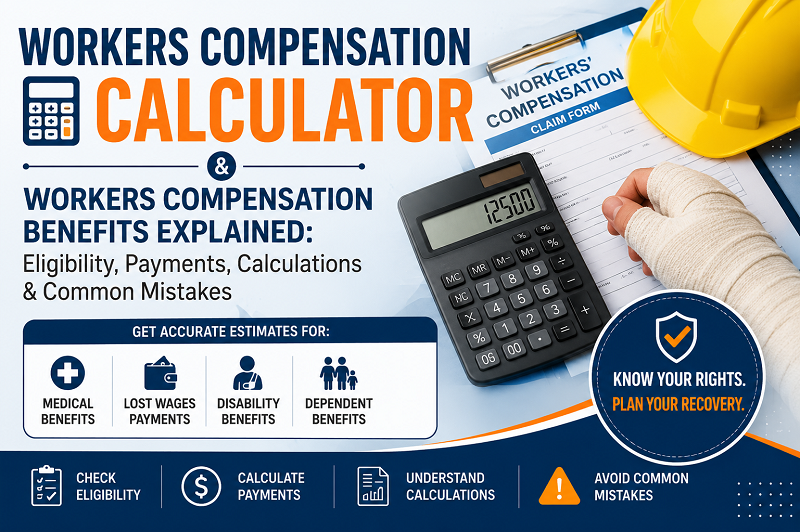
Workers Compensation Calculator
Workers Compensation Calculator
Estimates weekly wage-replacement benefits and a possible permanent impairment award.
Your Estimate
Want this estimate reviewed or want a professional to follow up? (Optional)
This calculator provides a rough, educational estimate only. It is not legal, financial, or tax advice, and results may not reflect your actual situation. Please consult a licensed attorney or professional before making decisions.
Frequently Asked Questions
Why two-thirds of my wage?
Many workers' compensation systems replace roughly two-thirds of lost wages during temporary disability, often subject to a state-set maximum and minimum weekly amount not reflected here.
Workers Compensation Benefits Explained: Eligibility, Payments & Common Mistakes
Getting injured at work can be stressful. Besides dealing with pain and recovery, many workers worry about how they will pay their bills if they cannot return to work immediately.
This is where workers’ compensation benefits come in. Workers’ compensation is a type of insurance that provides financial support and medical coverage to employees who are injured or become ill because of their job.
Many people use a Workers Compensation Calculator to estimate how much compensation they may receive. While these calculators provide useful estimates, understanding how workers’ compensation actually works helps you make better decisions and avoid costly mistakes.
In this guide, you’ll learn:
- What workers’ compensation is
- Who qualifies for benefits
- How compensation is calculated
- Different types of benefits available
- Common mistakes workers make
- How a Workers Compensation Calculator estimates payments
- Frequently asked questions
Whether you’re an employee, employer, student, or simply researching the topic, this guide explains everything in easy-to-understand language.
What Is Workers’ Compensation?
Workers’ compensation is a legal system that provides benefits to employees who suffer a work-related injury or illness.
Instead of filing a lawsuit against the employer, injured workers generally receive financial benefits through workers’ compensation insurance.
These benefits help cover:
- Medical expenses
- Lost wages
- Rehabilitation costs
- Disability payments
- Death benefits for surviving family members (in eligible cases)
The exact rules depend on the country, state, or province where the injury occurred.
Why Workers’ Compensation Exists
Before workers’ compensation laws were introduced, injured workers often had only one option—suing their employer.
This process was:
- Expensive
- Time-consuming
- Difficult to win
- Stressful for both employees and employers
Workers’ compensation laws were created to provide quicker financial assistance without requiring lengthy legal battles.
Today, most employers carry workers’ compensation insurance.
Who Is Eligible for Workers’ Compensation?
Not every injury automatically qualifies for compensation.
Generally, workers must meet certain conditions.
- You Must Be an Employee
Workers’ compensation usually covers:
- Full-time employees
- Part-time employees
- Seasonal workers
- Temporary employees
Independent contractors may not qualify in many jurisdictions.
- The Injury Must Be Work-Related
The injury or illness must happen because of your job.
Examples include:
- Falling from a ladder
- Back injury while lifting boxes
- Construction accidents
- Machinery accidents
- Slip and fall at work
- Exposure to dangerous chemicals
- Repetitive stress injuries
- Hearing loss from loud equipment
3. The Injury Must Be Reported
Most states require workers to report injuries within a certain number of days.
Waiting too long can reduce or even eliminate benefits.
- Medical Documentation Is Usually Required
Insurance companies often require:
- Medical examination
- Doctor’s diagnosis
- Treatment records
- Work restrictions
- Recovery estimates
Types of Workers’ Compensation Benefits
Workers’ compensation includes several different types of benefits.
Let’s look at each one.
1. Medical Benefits
Medical benefits pay for treatment related to the work injury.
These may include:
- Emergency care
- Hospital bills
- Surgery
- Doctor visits
- Prescription medicines
- Physical therapy
- X-rays
- MRI scans
- Rehabilitation
- Medical equipment
Workers usually do not pay these expenses themselves if the treatment is approved.
2. Temporary Total Disability (TTD)
If your injury prevents you from working temporarily, you may receive Temporary Total Disability benefits.
These payments replace part of your lost income until you recover enough to return to work.
3. Temporary Partial Disability (TPD)
Sometimes a worker can return to work but only with reduced hours or lower-paying duties.
Temporary Partial Disability helps compensate for the difference in earnings.
Example:
Previous weekly wage:
$1,000
Current reduced earnings:
$600
The worker may receive partial wage replacement depending on local laws.
4. Permanent Partial Disability (PPD)
Some injuries never fully heal.
Examples include:
- Loss of hearing
- Permanent shoulder damage
- Finger amputation
- Limited mobility
Workers may receive compensation even if they continue working.
5. Permanent Total Disability (PTD)
Serious injuries can permanently prevent someone from working.
Examples include:
- Paralysis
- Severe brain injuries
- Loss of multiple limbs
- Permanent blindness
These benefits often continue for many years or even life depending on local law.
6. Vocational Rehabilitation
If an injured worker cannot return to their previous job, workers’ compensation may pay for:
- New job training
- Career counseling
- Resume assistance
- Skill development
- Education programs
7. Death Benefits
If a worker dies because of a workplace accident, surviving dependents may receive benefits.
These often include:
- Funeral expenses
- Ongoing financial support
- Benefits for spouses
- Benefits for dependent children
How Workers’ Compensation Payments Are Calculated
Many people ask:
“How much workers’ compensation will I receive?”
The answer depends on several factors.
A Workers Compensation Calculator estimates benefits using information such as:
- Average weekly wage
- Disability percentage
- Time away from work
- Medical expenses
- State laws
- Benefit limits
- Waiting periods
Average Weekly Wage (AWW)
Most calculations begin with your Average Weekly Wage.
Example:
Suppose your last 52 weeks of earnings equal:
$52,000
Average Weekly Wage:
$52,000 ÷ 52
= $1,000
Wage Replacement Percentage
Most workers do not receive 100% of their wages.
Instead, many jurisdictions pay around two-thirds (approximately 66.67%) of the worker’s average weekly wage, subject to minimum and maximum limits set by law.
Example:
Average Weekly Wage:
$900
Replacement rate:
66.67%
Weekly compensation:
Approximately $600
Waiting Period
Some workers’ compensation systems have a waiting period before wage-loss benefits begin.
Medical treatment is often covered immediately, but income replacement may begin only after a specified number of days.
Disability Rating
Permanent injuries are often assigned a disability percentage.
Example:
- 5%
- 10%
- 25%
- 40%
- 60%
Higher disability percentages generally result in larger compensation awards.
State Benefit Limits
Each state may establish:
- Maximum weekly benefits
- Minimum weekly benefits
- Maximum number of payment weeks
- Special rules for certain injuries
Because of these differences, compensation amounts vary significantly.
Example Workers’ Compensation Calculation
Imagine the following situation:
Average Weekly Wage:
$900
Compensation Rate:
66.67%
Weekly Benefit:
Approximately $600
Time Off Work:
12 weeks
Estimated Wage Benefits:
$600 × 12
= $7,200
Medical expenses and other approved benefits would usually be paid separately if covered.
How a Workers Compensation Calculator Works
A calculator simplifies these calculations.
Typically, it asks for:
- Weekly wage
- Annual salary
- Hours worked
- Date of injury
- State or jurisdiction
- Disability percentage
- Time off work
- Medical expenses (if applicable)
The calculator then estimates possible compensation.
Remember:
A calculator provides only an estimate.
Actual benefits depend on:
- Insurance company decisions
- Medical reports
- Local laws
- Court rulings (if applicable)
- Employer insurance policy
Common Workplace Injuries Covered
Workers’ compensation commonly covers:
- Back injuries
- Neck injuries
- Broken bones
- Burns
- Cuts
- Machinery accidents
- Construction falls
- Head injuries
- Repetitive strain injuries
- Carpal tunnel syndrome
- Chemical exposure
- Hearing loss
- Occupational illnesses
- Workplace vehicle accidents
Common Mistakes Workers Make
Many employees accidentally reduce or delay their benefits.
Avoid these common mistakes.
Waiting Too Long to Report the Injury
Report workplace injuries as soon as possible.
Delays can create questions about whether the injury happened at work.
Not Seeing a Doctor Immediately
Medical records are essential.
Without proper documentation, proving your injury becomes much harder.
Ignoring Medical Advice
Skipping treatment or returning to heavy work too early may affect your claim.
Follow your healthcare provider’s recommendations.
Giving Incomplete Information
Always provide accurate details about:
- How the accident happened
- Where it occurred
- Witnesses
- Symptoms
- Medical history (when relevant)
Consistency helps avoid disputes.
Assuming Every Injury Is Covered
Not every injury qualifies.
For example, injuries unrelated to work or caused by certain forms of misconduct may not be covered under applicable laws.
Tips to Maximize Your Workers’ Compensation Claim
You cannot guarantee a larger settlement, but you can help protect your rights by:
- Reporting the injury immediately
- Seeking prompt medical care
- Following treatment instructions
- Keeping copies of medical records
- Saving receipts for approved expenses
- Maintaining records of missed work
- Communicating honestly with your employer and insurer
- Consulting a qualified attorney if your claim is denied or disputed
Why Medical Records Matter
Medical records provide evidence of:
- The injury
- Severity
- Recovery timeline
- Permanent limitations
- Future treatment needs
Well-documented medical evidence often plays a key role in determining benefits.
Can You Return to Work While Receiving Benefits?
Yes, depending on your condition.
Possible situations include:
- Full return to work
- Light-duty work
- Part-time work
- Modified responsibilities
If you earn less because of temporary restrictions, you may still qualify for partial benefits in some jurisdictions.
What Happens If Your Claim Is Denied?
Claims may be denied for several reasons, including:
- Late reporting
- Lack of medical evidence
- Disputes about whether the injury is work-related
- Missing documentation
- Failure to follow claim procedures
Many jurisdictions provide an appeal process where workers can challenge a denial.
Workers Compensation Calculator vs Actual Settlement
A calculator is a helpful planning tool, but it cannot predict your exact compensation.
Your actual payment depends on many factors, including:
- Medical evidence
- Applicable laws
- Insurance evaluations
- Disability assessments
- Lost wages
- Future medical needs
- Settlement negotiations (where applicable)
Use the calculator as an estimate—not a guarantee.
Frequently Asked Questions (FAQs)
Is workers’ compensation taxable?
In many jurisdictions, workers’ compensation benefits are generally not subject to income tax. However, tax treatment can vary depending on local laws and individual circumstances.
Can I be fired for filing a workers’ compensation claim?
Many jurisdictions prohibit employers from retaliating against employees solely for filing a legitimate workers’ compensation claim. Employment laws vary, so legal protections depend on where you work.
Do all employers have workers’ compensation insurance?
Many employers are legally required to carry workers’ compensation insurance, but the rules depend on the jurisdiction and factors such as business size or industry.
How long do benefits last?
The duration depends on:
- Type of injury
- Recovery time
- Disability rating
- Local laws
Some benefits last only a few weeks, while others may continue for years.
Should I use a Workers Compensation Calculator?
Yes. It is a useful way to estimate potential wage-loss benefits and better understand how different factors affect compensation. Keep in mind that the final amount is determined through the official claims process.
Final Thoughts
Workers’ compensation provides an important financial safety net for employees who are injured or become ill because of their work. It can help cover medical treatment, replace part of your lost wages, and provide support if an injury causes temporary or permanent disability.
Understanding how eligibility, benefit types, and compensation calculations work can make the claims process less confusing. A Workers Compensation Calculator is an excellent starting point for estimating potential benefits, but it cannot account for every legal or medical detail that may affect your claim.
If you have suffered a workplace injury, report it promptly, seek medical care, keep detailed records, and follow your employer’s reporting procedures. When questions or disputes arise, professional legal advice may be appropriate.
By understanding your rights and responsibilities, you can make more informed decisions and better protect your financial future after a workplace injury.